News
Luxury Vinyl Plank vs Laminate: Which Floor Fits Your Home

U.S. luxury vinyl tile and plank volume demand grew at an average rate of 28% per year between 2012 and 2022, while its share of the total flooring market increased from 4% to 31%, according to Freedonia's flooring industry study. For most homes, luxury vinyl plank is the safer default in kitchens, bathrooms, laundry rooms, and entryways, while laminate remains a sound wood-look choice for dry bedrooms, living rooms, and offices where spills are rare. Heat exposure deserves the same attention as water, because a sunny, unconditioned room can challenge either floor.
Table of Contents
- Luxury Vinyl Plank vs Laminate at a Glance
- What Each Floor Is Built From
- How Each Handles Water and Humidity
- Heat, Sun and Temperature Swings
- Feel, Sound and Look Underfoot
- Upkeep, Repairs and Long-Term Wear
- Replacing and Disposing of Old Floors
- What Each Option Costs by the Box
- Choose the Right Floor for Each Room
Luxury Vinyl Plank vs Laminate at a Glance
The Luxury Vinyl Plank vs Laminate decision starts with room exposure. Kitchens, bathrooms, laundry rooms, and entryways point toward luxury vinyl plank. Dry bedrooms, living rooms, and offices can suit laminate well.
That preference shows in national sales. In the United States, LVT accounted for 27.6% of total floor-covering dollar sales and 30.9% of total square-foot sales in 2023, while laminate represented 3.3% of dollar sales and 3.0% of square-foot sales, according to Catalina Research figures published via CTaSC. Sales share doesn't prove a floor fits a particular room, though. It shows where buyers and specifiers have placed most recent demand.
Luxury Vinyl Plank and Laminate Side by Side
| Factor | Luxury vinyl plank | Laminate |
|---|---|---|
| Core material | Synthetic PVC-based vinyl layers, often with a rigid SPC or WPC core | Wood-fiber or high-density fiberboard core under a photographic layer |
| Water tolerance | Waterproof constructions are widely available | Basic products may tolerate standing water for about 24 hours; water-resistant products up to 48 hours |
| Heat and sun | Rigid cores can move under repeated heat; SPC is generally more dimensionally stable than WPC | Also responds to humidity and temperature; check manufacturer limits |
| Look | Wood or stone print with textures that can be embossed | Photographic print under a clear protective surface |
| Upkeep | Sweep, then damp mop with the cleaner the manufacturer recommends | Wipe spills promptly, since water at seams is the main failure point |
| Typical service life | 10 to 20 years with proper installation and maintenance | 10 to 20 years with proper installation and maintenance |
The table gives typical values. The selected product's specifications govern water exposure, cleaning, expansion gaps, and installation conditions.
Two questions narrow the choice fastest. What reaches the floor during normal use, and how should the finished surface feel underfoot?
Nexora Flooring sells luxury vinyl plank and tile alongside laminate click boards that fit together fast, so both constructions can be compared in one place. A buyer can start with the luxury vinyl plank and tile collection, then check laminate options against the same room measurements and exposure notes.
What Each Floor Is Built From
Construction explains most performance differences. A plank's visible surface gets the attention, but its core determines how it responds to water at seams, temperature change, and minor subfloor irregularities.
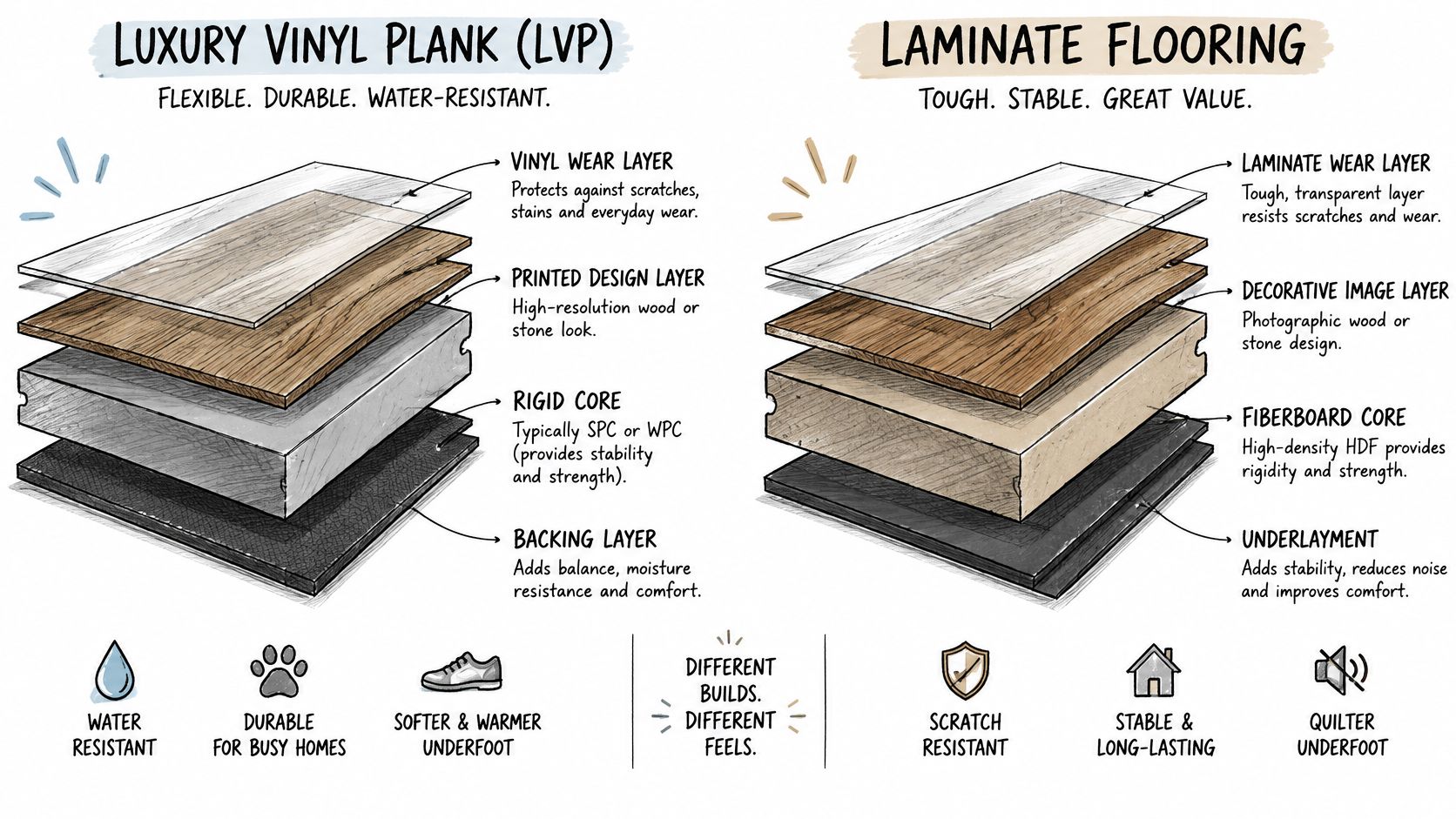
The layered build of each product appears in the comparison diagram below.
Laminate Layers
Laminate flooring is a multi-layer synthetic product made by fusing layers through a lamination process, and its appearance comes from a photographic applique layer placed beneath a clear protective surface, according to Utah State University Extension educational material. The visible grain or stone pattern is therefore an image, not a natural wood or stone wear layer. Under that image sits a wood-fiber or high-density fiberboard core, followed by a backing layer.
That fiberboard gives laminate a firm feel. It also creates the main vulnerability. If water passes through a joint or reaches a cut edge, the core can absorb it and swell. The clear top layer protects the print from ordinary wear, so damage through that surface can't be sanded away like damage to solid wood.
Luxury Vinyl Plank Layers
Luxury vinyl plank is built primarily around vinyl layers. A transparent wear layer protects the printed pattern. Beneath it, the core may be flexible vinyl or a rigid composite. A backing layer completes the plank and may add cushioning or sound control, depending on the product.
Two rigid-core terms appear often on spec sheets:
- SPC: Stone-plastic composite, generally the more dimensionally stable rigid option.
- WPC: Wood-plastic composite, generally softer underfoot than SPC.
Vinyl wear layers are measured in mil. A thicker wear layer gives the printed design more protection in a busy entry, kitchen, or hallway. Thickness alone doesn't describe the whole product, so a thin plank with a substantial wear layer can serve a different purpose from a thick plank with a thin wear layer.
ASTM F3261 covers resilient flooring in plank or tile form with a protective wear layer. The standard helps buyers compare resilient products on defined terms, but it doesn't make every luxury vinyl plank identical. Core formulation, lock design, total thickness, and backing still vary.
A practical reading order keeps spec sheets manageable. Check the core first, then wear layer, total thickness, backing, and locking system. That sequence connects each listed feature to water behavior, surface life, feel, and installation method.
How Each Handles Water and Humidity
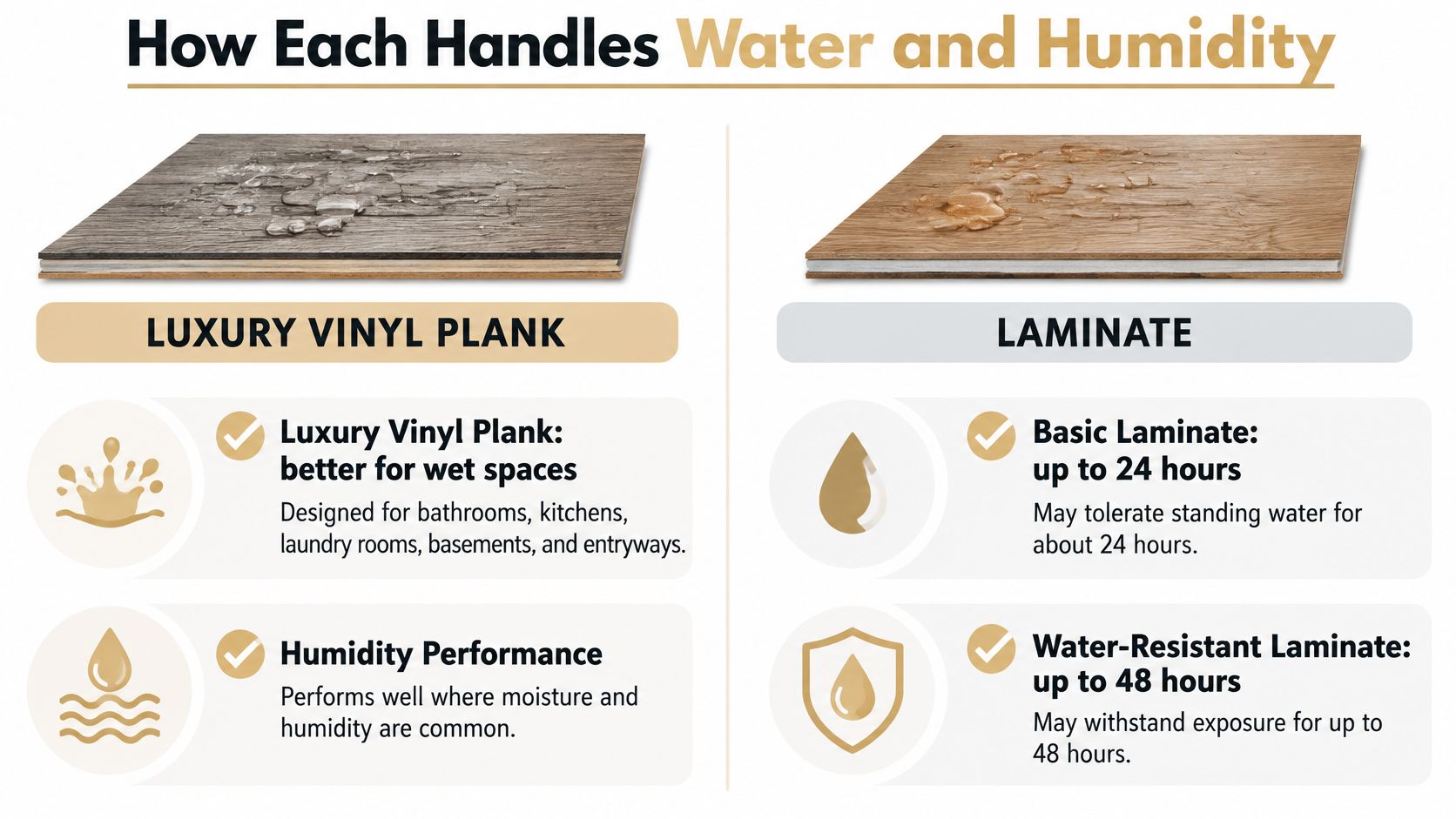
Consumer guidance gives laminate a useful time benchmark. Basic laminate products may tolerate standing water for approximately 24 hours, while some more water-resistant products may withstand exposure for up to 48 hours, according to Better Homes and Gardens guidance on vinyl and laminate service life. The same guidance places both vinyl and laminate commonly at 10 to 20 years with proper installation and maintenance.
Those times aren't permission to leave a puddle overnight. They're practical benchmarks, not guarantees for every plank or installation.
The checklist below separates those laminate limits from the wider wet-room role of waterproof vinyl constructions.
Where Water Enters
A laminate surface may shed a fresh spill while the seams remain exposed to risk. Water that reaches joints or cut edges can enter the fiberboard, causing swelling and permanent distortion. Once an edge lifts or a joint peaks, drying the surface doesn't restore the original shape.
Waterproof luxury vinyl plank constructions are widely available because the core is synthetic. A documented waterproof plank gives the homeowner more time to find and clean a spill. It doesn't turn the finished floor into a sealed pan. Water can still pass through poorly fitted seams, perimeter gaps, or transitions and reach the subfloor.
Practical rule: Waterproof describes the plank construction stated by the manufacturer. It doesn't excuse gaps at walls, loose transitions, or an untested wet subfloor.
Rooms Where the Difference Matters
Bathrooms combine splashes with sustained humidity. Laundry rooms add appliance leaks, while basements can introduce moisture from below. Kitchens concentrate water around sinks and dishwashers, and entryways receive rain, snow, and wet footwear. Those conditions favor a vinyl product whose documentation explicitly calls it waterproof.
A dry bedroom presents a different calculation. Laminate can perform well there when drinks and pet accidents are cleaned promptly and the subfloor stays dry. The term water-resistant laminate shouldn't be treated as equal to waterproof luxury vinyl plank, because the core materials and failure paths differ. More detail on that distinction appears in the guide to waterproof flooring and laminate.
The video below provides a visual walk-through of the water comparison before the final pre-order checks.
Before ordering boxes, a buyer should confirm these product-specific points:
- Water instructions: Read the exact exposure language rather than relying on the product category.
- Joint requirements: Check whether installation requires seam treatment or special perimeter detailing.
- Expansion rules: Confirm the gap required at walls and fixed objects.
- Underlayment rules: Verify whether added underlayment is allowed or prohibited.
- Subfloor moisture limit: Measure the subfloor against the manufacturer's stated limit.
That checklist prevents a common ordering mistake. The room may suit the material category while the selected plank, underlayment, or subfloor condition fails the written requirements.
Heat, Sun and Temperature Swings
A sunroom exposes the weakness in simple room-label advice. The room may stay dry, yet direct afternoon sun can heat the floor surface day after day. Water resistance answers one question. Heat tolerance answers another.
Rigid-core vinyl can move when exposed to repeated heat cycles, potentially opening joints or causing peaking if expansion gaps and product limits aren't respected, and SPC cores are generally more dimensionally stable than softer WPC cores, according to The Honest Reviewers' LVP vs laminate comparison. This makes the familiar phrase worth remembering: “waterproof” does not mean “heat-proof.”
Laminate doesn't escape the issue. Its fiberboard core responds to humidity and temperature changes, and an installation that leaves too little room for movement can buckle or peak. A warm room therefore requires product limits for either material, not an automatic switch from vinyl to laminate.
Exposure Cases That Need a Closer Check
- Sunrooms: Confirm the manufacturer's limits for direct sun and room temperature before selecting a plank.
- Large south or west windows: Observe where afternoon sun lands and consider window coverings where the manufacturer permits them as a control measure.
- Unconditioned enclosed porches or garages: Ask whether the product allows spaces without stable heating and cooling.
- Radiant heat: Confirm compatibility and the maximum permitted system setting in the installation instructions.
- Wide sunny spans: Check whether the product requires expansion breaks across long or broad runs.
Acclimation belongs in the same conversation. Boxes should be kept flat, dry, and indoors, and wood-based laminate needs time to settle in the room before installation, as the installer specifies. Vinyl products have their own acclimation instructions, so the installer shouldn't transfer one product's timing to another.
Subfloor moisture still matters in a sunny room. Heat can reveal movement at the joints, while moisture below the floor can affect the installation separately. Testing the subfloor and preserving the required expansion gap address different risks.
Bring the installer notes about window direction, unshaded glass, room conditioning, and any radiant heat before ordering boxes.
That information may change the core selection or rule out a product entirely. It gives the installer the exposure facts needed to compare the written limits with the actual room.
Feel, Sound and Look Underfoot
Say a homeowner walks barefoot from a kitchen into an adjoining living room. The eye reads one continuous wood pattern, but the foot notices firmness, surface texture, and any movement at the joints. Sound becomes clearer when a dog crosses the room or a chair leg shifts.
Both materials create their wood or stone appearance with a printed design. Laminate places that image below a clear protective surface. Luxury vinyl plank can add embossed texture, so low light may catch raised grain lines and make the pattern feel less flat. Product quality varies, so a photograph online can't settle how convincing either surface looks at standing height.
Thickness and Sound
The available vinyl range includes thicknesses from 2mm to 6.2mm. A thicker rigid plank generally feels firmer and more substantial than a thin flexible plank, although the subfloor and backing influence the result. A thin product can also telegraph subfloor imperfections more readily, so surface preparation matters.
Sound doesn't come from the decorative face alone. Underlayment, attached backing, subfloor construction, rugs, and furniture all shape footfall noise. The buyer should check the product's underlayment requirements instead of adding a soft layer that the locking system doesn't support. The guide to the best underlayment for vinyl plank flooring covers when a plank needs one at all.
Plank Size and Room Proportion
Vinyl plank sizes listed on the collection include 6 x 24 in, 7 x 48 in, 9 x 60 in, 12 x 24 in, 18 x 36 in, and 24 x 24 in. Longer planks create fewer end seams in a long room and can make the layout look calmer. Tile-format pieces suit stone patterns where a grid or staggered tile layout looks more natural.
Samples settle questions that dimensions can't. Nexora Flooring posts samples on request so customers can see the color and texture in their own light. A useful test places each sample beside cabinets and trim, then checks it in morning and evening light. The homeowner can also walk across the sample area in socks and shoes, roll a chair near its edge, and view the print from the doorway before committing to boxes.
Upkeep, Repairs and Long-Term Wear
Daily care is simple when the sequence stays consistent. Grit causes much of the visible dulling because shoes grind it across the protective surface.
- Remove grit: Dry sweep or vacuum with a hard-floor setting.
- Damp mop: Use the cleaner named or allowed by the manufacturer.
- Dry the seams: Avoid leaving water standing along joints or transitions.
That routine suits both floors, with one timing difference. Laminate needs spills wiped promptly because water at a joint can reach the fiberboard. A waterproof vinyl construction tolerates the same spill better, although standing water still shouldn't be left to find a perimeter gap or damaged seam.
Cleaners and Steam
Steam mops and harsh cleaners require caution. Heat, excess moisture, or an incompatible chemical can affect the surface or locking joints. The product's cleaning limits should be checked before either tool is used. A cleaner that's safe for tile may leave residue on vinyl or damage a laminate finish.
Furniture pads reduce another avoidable source of wear. Chair legs should glide without dragging grit, and heavy appliances should be moved on protective panels rather than slid across either floor.
Wear Layers and Surface Life
Vinyl's wear layer protects its print. A thicker layer, measured in mil, gives busy kitchens and pet homes more surface protection than a thin layer. Laminate's clear protective top performs the corresponding role. When that surface wears through, the decorative image loses protection and the plank can't be refinished back to its original appearance.
Neither floor should be sanded like solid hardwood. A damaged plank in either system can usually be replaced individually when the owner has matching material. Keeping spare planks from the same production run improves the color match, so offcuts and an extra box have practical value after installation.
Wipe spills within minutes and keep grit off the floor. That habit prevents many early seam and surface failures.
A mat inside the main entry supports the same goal. It captures water and abrasive particles before shoes spread them across the room.
Replacing and Disposing of Old Floors
A floor usually comes out for one of two reasons: water reached the core, or years of sun and heat faded and stressed the surface past repair. Either way, removal changes the budget and schedule for a replacement project. The first task is identifying the material coming up, because vinyl and laminate may follow different disposal routes. Age, adhesive, underlayment, and attached backing can also affect handling.
Recycling access remains uneven. The New York City Department of Design and Construction notes that publicly available estimates for post-consumer vinyl-flooring recycling are lacking, in its vinyl flooring report. That gap means a homeowner shouldn't assume the local hauler accepts removed planks for recycling.
The city or county solid-waste office can state what it accepts. The installer can also explain whether clean removed material must be separated from general demolition debris. Those questions work best before removal day, while the crew can still plan bags, hauling, and workspace protection.
A clear removal sequence helps:
- Protect reusable trim: Pull baseboards and transition strips carefully if they will be reused.
- Sort removed material: Bag loose planks and offcuts by room so quantities can be counted.
- Assign hauling: Confirm whether the installer or homeowner will transport the material away.
Timing matters on the delivery side too. New boxes need to stay flat, dry, and indoors, and laminate needs time to settle in the room before it is laid, as the installer specifies. Clearing the old floor early gives the new material a dry staging area instead of a crowded hallway.
Removal and disposal questions can be raised while requesting an estimate through the estimate form, so the homeowner can ask about them before the new boxes arrive.
What Each Option Costs by the Box
Flooring is ordered by the box, so room measurements need to become a whole-box count. The per-square-foot price helps compare products, but the per-box total shows the amount leaving the budget.
Every product in our vinyl plank collection and laminate collection lists the sq ft per box next to the box price, so the steps below work straight from the product page.
- Measure each room: Multiply length by width in feet to get sq ft.
- Add waste: Allow extra material for cuts and pattern matching, with more for angled layouts or many corners.
- Divide by box coverage: Use the coverage on the product page, then round up to whole boxes.
- Price the order: Multiply the box count by the per-box price.
For illustration, a 12 ft by 14 ft room contains 168 sq ft. A 10 percent waste allowance brings the order to about 185 sq ft. If a product page lists a typical 20 sq ft per box, the order is 10 boxes. Coverage varies by product, so the buyer should check the product page for exact coverage.
Listed vinyl prices range from $1.84 to $5.34 per sq ft in the sample products below. Nexora Flooring shows vinyl prices per sq ft and per box, which makes both comparisons visible.
Sample Luxury Vinyl Plank Prices per Sq Ft and per Box
| Product | Thickness | Price per sq ft | Price per box |
|---|---|---|---|
| Happy Feet International Stone Elegance II, 7.25 x 48 in, SPC | 6.2mm 20 mil | $3.49 | $83.76 |
| MS International Wilmont, 7 x 48 in LVP | 2.5mm 20 mil | $2.05 | $80.86 |
| MS International Acclima, 7 x 48 in LVP | 2mm 12 mil | $1.84 | $81.90 |
| MS International Trecento, 12 x 24 in LVT RigidCore | 5mm 12 mil | $2.85 | $55.16 |
| Daltile Loften, 6 x 24 in LVT | 3mm 30 mil | $5.34 | $192.24 |
The box calculator takes a room size, includes waste allowance, and rounds up to whole boxes. Thickness, core, and wear layer should be compared before price, because a lower-priced thin plank and a higher-priced rigid plank solve different problems. Laminate pricing isn't covered in the table, so the same four steps should be applied on its product page. Readers comparing wood-look floors with genuine wood can also review the guide to the cost of new hardwood floors.
Choose the Right Floor for Each Room
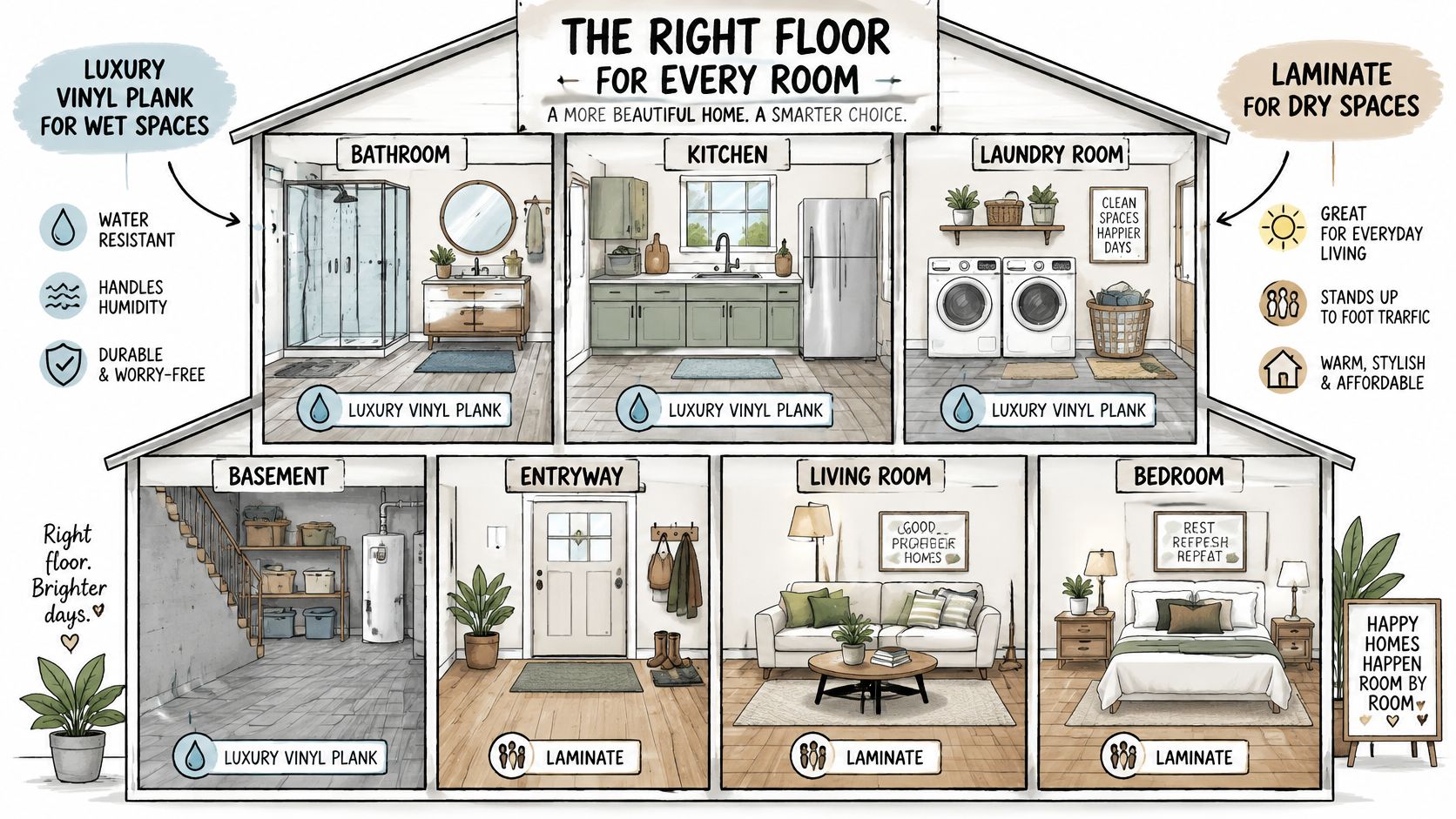
Room names provide a starting point, not a specification. The table below connects each space to the exposure that usually drives the Luxury Vinyl Plank vs Laminate choice.
Floor Choice by Room and Exposure
| Room or exposure | Better fit | Why |
|---|---|---|
| Bathroom | Luxury vinyl plank | Standing water and humidity are routine |
| Kitchen | Luxury vinyl plank | Spills and water near sinks and dishwashers |
| Laundry room | Luxury vinyl plank | Frequent water exposure |
| Basement | Luxury vinyl plank | Moisture risk from below; check the subfloor first |
| Entryway | Luxury vinyl plank | Grit and wet footwear |
| Living room | Laminate or luxury vinyl plank | Low moisture; choose by look and feel |
| Bedroom | Laminate or luxury vinyl plank | Low moisture and light traffic |
| Office | Laminate or luxury vinyl plank | Dry conditions; choose by look and sound |
| Sunroom or large south or west-facing window | Either, after checking limits | Heat and expansion gaps decide the product |
The diagram below maps those picks across common household rooms.
Decision Steps
First, match the room's water and sun exposure to the table. A basement with historic dampness needs a subfloor check before any product is selected. A dry living room with a wide west-facing window needs a heat check even though moisture risk is low.
Next, confirm the selected product's written limits. The subfloor determines which vinyl type fits, especially where flexibility, rigidity, or attached backing affects installation over the existing surface. Pet traffic adds another practical filter, and the guide to the best floor for dogs covers cleanup and claw-related considerations.
Then measure every room separately. Closets, angled walls, and transitions change the box count, so one combined house measurement can produce the wrong order. The box calculator converts each room's sq ft into whole boxes with waste included. To turn a room size into packs, use the laminate and vinyl plank flooring calculator.
Specification check: A room can favor vinyl for water and still need a different vinyl core because of heat, subfloor flatness, or sound goals.
Customers who are unsure can send in the room details and request a free estimate through the estimate form. Useful details include room dimensions, current floor material, subfloor type, window direction, and photos of transitions or problem areas. That information lets the estimate address product fit and removal rather than box quantity alone.
Nexora Flooring ships its luxury vinyl plank and tile across the U.S., so a homeowner, contractor, or designer can order by the box without coordinating around a local pickup. The next step is concrete: measure each room, run the calculator, and request the estimate with room sizes and subfloor photos.
Measure each room, note its water and sun exposure, and compare matching luxury vinyl plank, tile, and laminate options by the box at Nexora Flooring. The product pages show prices per sq ft and per box, and samples can be requested to check color and texture at home. Send the measurements and subfloor photos with an estimate request so the recommended floor fits the room rather than only the budget.