News
Zellige Tile Bathroom: Where It Works and What It Costs

Zellige is a handmade, glazed ceramic tile made from small, irregular pieces, and in a bathroom it suits tub surrounds, vanity backsplashes, niche walls and shower walls, as long as the wall behind it is a properly waterproofed assembly. Shower floors and main bathroom floors need a separate check of the tile's own test data before any box is ordered, as covered in the guide to a hexagon tile bathroom floor.
A homeowner has three zellige samples lined up on the vanity, a contractor asking for a decision by Friday, and a bathroom stripped back to the studs. In the photograph the samples look nearly identical. What separates them is a document nobody has opened yet: the technical sheet that states absorption, approved application areas, slip performance and wear classification.
That sheet sets the order, and so does the assembly behind the tile. Both are worth working through one bathroom area at a time, because the same carton can be right for a vanity wall and wrong for a shower pan.
Table of Contents
- Zellige Tile in a Bathroom at a Glance
- What Zellige Is and Why No Two Pieces Match
- Water Absorption and Waterproofing Basics
- Shower Floors and Slip Resistance
- Layouts, Grout and Color Choices
- Installation Factors and Long-Term Upkeep
- How Many Square Feet to Order
- Budget and Order Your Zellige Bathroom Tile
Zellige Tile in a Bathroom at a Glance
The verdict changes with the surface. A zellige tile bathroom is best planned area by area, since suitability is decided by what sits behind the tile and by the ratings printed for that exact product.
| Bathroom area | Typical suitability | Condition to verify |
|---|---|---|
| Shower walls | Common use | Waterproof membrane behind the tile and a stated absorption classification |
| Tub surround | Common use | Membrane sealed at the tub flange and corners |
| Vanity backsplash | Suitable | Placement in a drier zone and an easy-clean grout choice |
| Niche and accent wall | Suitable | Membrane continued into the niche and sealed at its edges |
| Shower floor | Verify first | Floor-rated product, wet-area slip performance and grout layout |
| Main bathroom floor | Verify first | Floor-rated product with a wear classification and slip rating |
Two rows carry most of the risk. A shower floor and a main bathroom floor both put the tile underfoot, where slip resistance, joint width, slope toward the drain and standing water change the answer entirely. A wall-rated product can perform beautifully on a vertical surface and still be the wrong material beneath a bare foot, and a textured face does not settle that question.
The deciding document: a manufacturer's technical sheet states the absorption classification, the approved application areas and, for floor products, the measured slip performance. A styled photo on a product page doesn't replace it.
Buyers who want to see how the variation reads across a full range can browse Marazzi Zellige Neo and the mosaic collection while working through the checks. The path that follows runs from how the tile looks, to how it handles water, to what it does underfoot, then layout, upkeep, quantity and cost.
What Zellige Is and Why No Two Pieces Match
A single zellige tile sits in the hand like a shard of glazed pottery. The face is glassy in one spot and satiny in another, the edge wanders by a fraction of an inch, and the thickness shifts from corner to corner. Tilted toward a window, the glaze moves from pale to deep across the same piece.
The illustration below shows how wide that range can run inside one colorway.
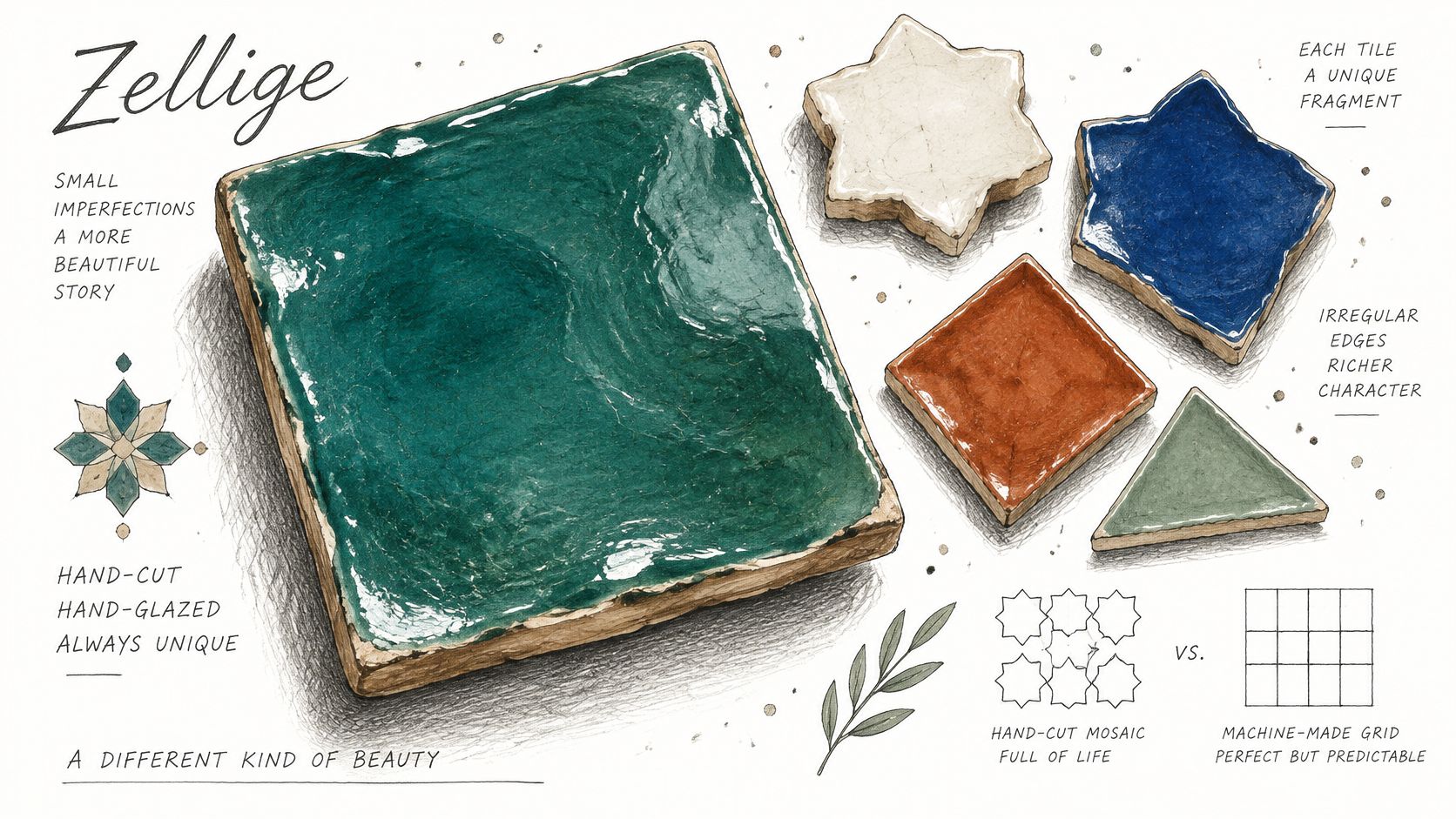
That variation is the product. Historical accounts place Fez zellige among Morocco's oldest decorative architectural elements, with examples dating to the 13th century, including work associated with the Seffarine Madrasa minaret and the Fes Jedid Grand Mosque, as Morocco World News reports. Artisans shaped, glazed and assembled the pieces for mosques, madrasas, palaces, fountains and traditional houses.
The fountains are the part that matters for a bathroom. Small glazed pieces were already at home in water settings long before anyone tiled a shower, which is why the move into shower walls, niches and vanity surrounds reads as an extension of the craft rather than a styling trick. The tradition behind it has run for roughly 800 years, according to the same account.
A useful comparison is a hand-cut mosaic next to a printed photograph of the same scene. At arm's length the two look alike. Up close, every hand-set piece carries a small shift in edge, thickness and glaze, and the eye reads those shifts as depth rather than as error.
Telling handmade from zellige-look
The test costs nothing. If a display holds twenty pieces and every one is identical in tone, edge and thickness, the product is more likely a machine-made zellige-look tile. That's a legitimate choice for a bathroom wall, and it has to be judged on its own absorption and slip data instead of on the handmade name.
Water Absorption and Waterproofing Basics
Absorption is a measured property
The glaze looks like a seal. Water performance is decided underneath it, by the ceramic body's absorption and by the waterproofing an installer builds behind the tile.
ISO 10545-3 specifies a test method for determining ceramic tile water absorption, apparent porosity, apparent relative density and bulk density, and the results are used for tile classification and product specifications, per the standard's listing. That's the reference to look for on a spec sheet.
In plain terms, an impervious porcelain body takes on almost nothing, a vitreous ceramic body takes on a little, and a porous terracotta body takes on a great deal. Zellige-style wall tiles commonly sit in the vitreous middle, while some handmade bodies run wetter. The classification printed for the exact product, together with its approved application areas, is what tells a buyer whether it belongs in a shower or only on a dry wall.
The membrane does the waterproofing
The Tile Council of North America is direct on this point: grout joints are not waterproof, and in a shower the substrate and the installation method have to protect the adjacent construction from moisture, as the TCNA ceramic tile FAQ explains. Zellige-specific installation guidance asks the same of the substrate, which must be sound, clean, level and waterproofed before the first piece goes up, because water migrates through joints and through the small irregularities in a handmade face.
On a real job that means a code-compliant shower waterproofing system behind the wall tile, lapped into the drain and over the curb, with corners, niches, benches and pipe penetrations sealed to the membrane maker's own details. A bead of caulk along the surface and a penetrating sealer applied after grouting can't stand in for a membrane that was never installed.
Material families differ in how they take water, and the same reasoning that separates porcelain tile from marble tile applies inside a shower: the rating printed for the product outranks the category name.
Estimating follows the same split. Membrane, thin-set, grout, corner pieces, compatible sealant and the zellige finish are separate line items with separate quantities. A budget built only from tile square footage comes up short every time.
Shower Floors and Slip Resistance
An uneven face feels reassuringly grippy under a dry hand. Wet, with soap in the water, that same surface can behave nothing like it did in the showroom, and texture under the fingertips says little about the number a lab measures.
Slip resistance for tile is measured as dynamic coefficient of friction, or DCOF, under ANSI A326.3, and that test method is what to look for on a technical sheet. Zelij's installation catalogue notes that a DCOF of at least 0.42 is commonly recommended for interior areas where moisture may be present, and it advises confirming a specific product's testing and intended application before wall-oriented zellige goes onto a shower floor.
Not every glazed zellige clears that mark. Mosaic Factory's installation and maintenance instructions report a DCOF of 0.16 for glazed zellige and note that slip resistance can be raised through wider grout joints or an anti-slip treatment. Both statements help, and neither settles the question for a different product.
Four things change how a tiled floor feels underfoot when wet: joint width, piece size, slope toward the drain, and how much water stands on the surface between showers. Wider joints give a wet foot more edge to catch. Small pieces break up a film of water. A floor that drains properly never holds the puddle that turns a glossy glaze into a hazard.
Ask for the report: a DCOF figure taken from ANSI A326.3 testing of the exact SKU and finish is the only slip number worth acting on.
Questions worth putting to the installer before the order:
- Where is the test data for this exact product and finish, not the collection as a whole?
- Is it rated for floor use in a wet area, or only approved for walls?
- How does the floor slope toward the drain, and who verifies that before tile goes down?
- What does local code require for the shower pan and the drain assembly?
Until those answers are in hand, a wall-rated zellige shouldn't be ordered for a shower pan. The same carton can be right above the shower head and wrong beneath it.
Layouts, Grout and Color Choices
Laying zellige is closer to building a hand-set brick wall than to installing calibrated tile. Each unit is a little different, joints wobble when a setter chases perfection, and the eye reads the whole field rather than any single piece. Layout and grout color set the mood before a glaze is chosen.
The watercolor below shows how three tones sit together across one field.
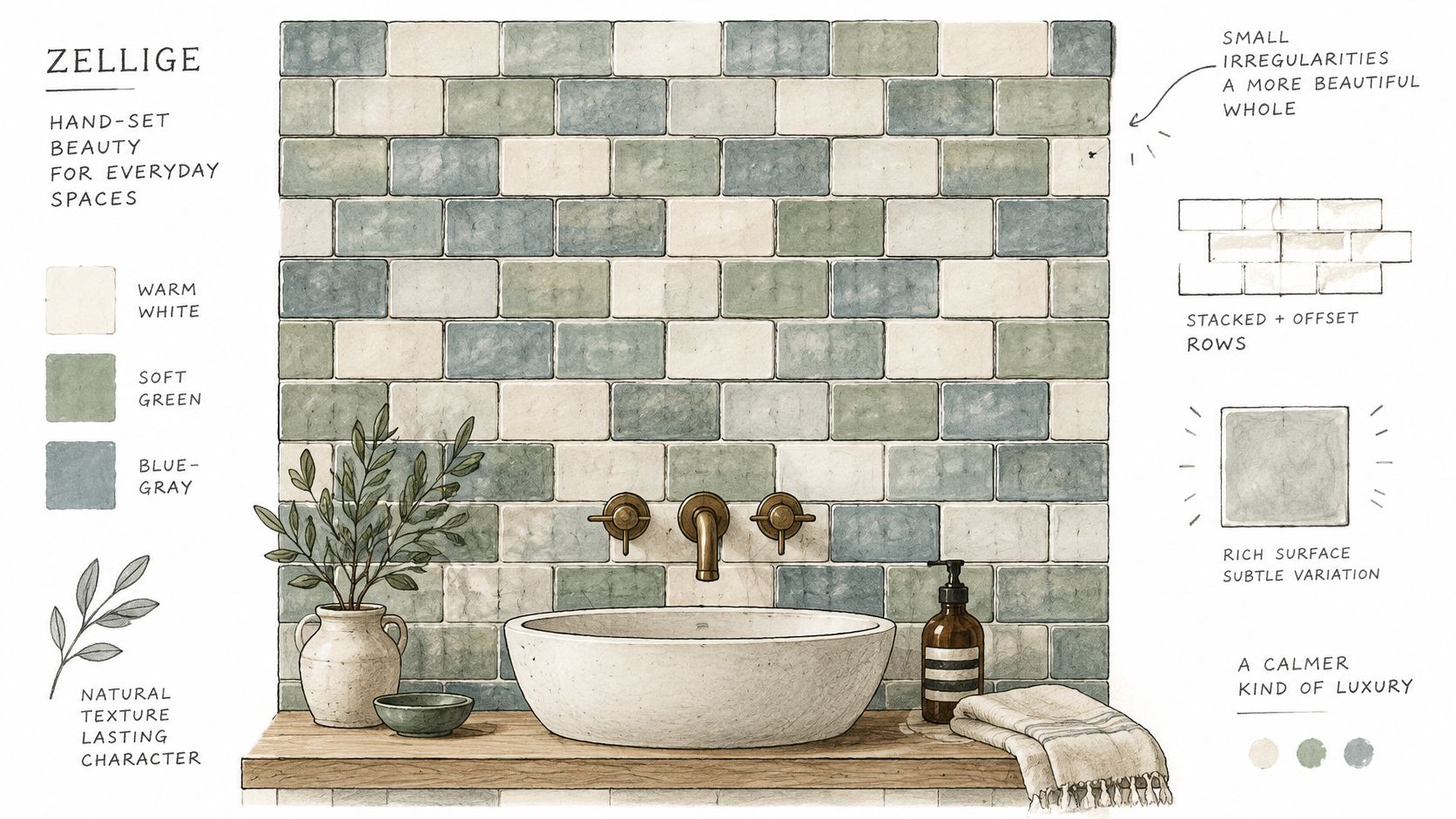
Running bond is the calm choice, since offset rows soften irregular edges and read as traditional without shouting. Stacked joints turn a wall into a modern grid, and they show every difference in size and thickness, so the sort-and-blend step matters more. Herringbone and chevron make a single feature wall the focal point, and the constant change of direction turns tonal variation into movement.
Grout color does the visual work
Zellige is typically set edge to edge with minimal joints, so grout carries a lot of the design.
A grout matched closely to the tile reads as a quiet, continuous surface and hides small shifts in size. A contrasting grout outlines each piece, puts the handmade edges on display and makes the wall busier. Neither choice is more correct. They answer different questions about the room.
Warm white, sand and terracotta pair well with wood vanities and warm metals. Blue and green glazes hold more depth in a small room and look best when the rest of the palette stays quiet. Pale or translucent glazes can let the setting bed show through, which makes a white thin-set the safer default under light finishes. Warm palettes are the easier half of the decision, and what colors go with terracotta floor tiles handles the floor side of that pairing.
Tile is made in batches, and shades drift between batches, so the whole room should be ordered together. Boxes from a single delivery still vary, so pieces from several boxes should be laid out on the floor and checked before any are set.
Installation Factors and Long-Term Upkeep
Before the first tile goes up
The substrate has to be sound, clean, level and waterproofed, and moisture control belongs in the same phase. A bathroom fan is the tool that does it.
EPA guidance citing ASHRAE 62.99 gives two bathroom exhaust targets: 25 cubic feet per minute for a continuously operating fan or 50 cubic feet per minute for a fan operated as needed, and the exhaust should discharge directly outdoors rather than into an attic or another enclosed space, per the EPA's remodeling guidance. The same guidance notes that wet or damp materials should dry within 24 to 48 hours to reduce the chance of mold growth.
Setting the tile
The sequence below is the order of work on a shower wall.
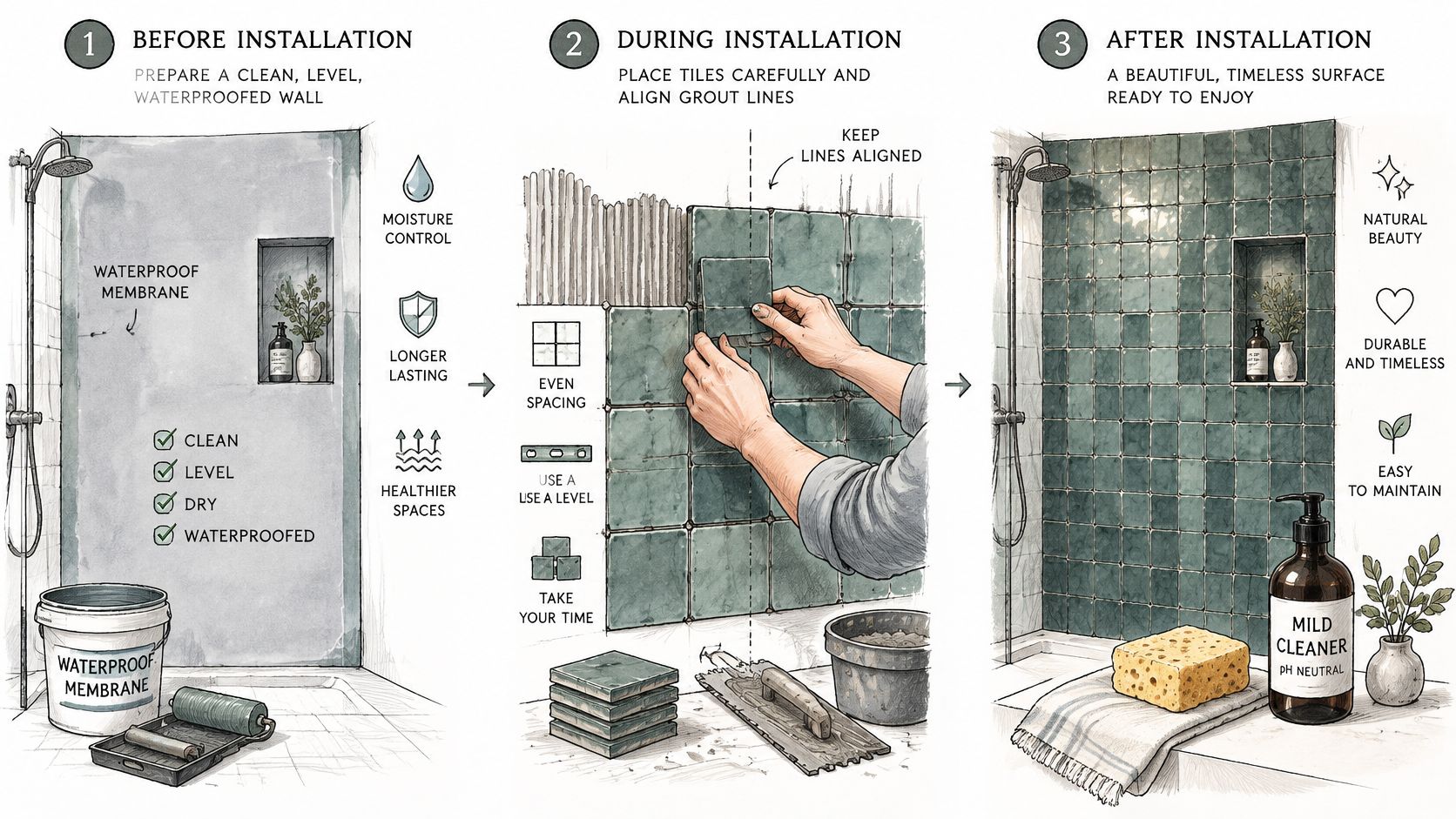
Sorting comes first. Pieces go into piles by tone and thickness, then get dry-laid across the floor to plan the blend across the wall. Each piece is back-buttered so an uncalibrated body gets continuous adhesive contact, and the field is set edge to edge with minimal joints rather than with conventional spacers.
Movement joints have to continue through the tile wherever the substrate requires them. The Tile Council of North America's guidance on joint placement recommends allowing for expansion and contraction in every tile installation and placing joints more frequently in areas exposed to moisture, which describes a wet shower zone precisely. The same reasoning that weighs material against setting conditions in slate flooring pros and cons applies here: the surface is only as good as the assembly it sits on.
What upkeep actually looks like
Daily care is a wipe. A squeegee or towel over the shower walls after the last shower keeps hard water and soap film out of the small dips in a handmade face.
Monthly, grout and caulk get a look, especially at inside corners and where the wall meets the shower floor. Yearly, grout lines get checked for cracks and soft spots. Excess grout needs to come off the surface irregularities soon after setting, while it's still soft, because a cured smear inside a glaze dip is far harder to lift than one caught the same day.
Sealing splits into two questions. A glazed face generally doesn't need a sealer to perform, since the glaze is already the barrier, while grout joints are another material entirely. Zia Tile's care guidance notes that exposed zellige and grout may need resealing at least every one to two years, with more frequent attention in high-moisture or high-wear conditions. The product's own instructions settle which case applies.
Skip abrasive powders, scouring pads and aggressive grout removal on a glazed face. They dull the surface and open the small pits that collect dirt. Keep a handful of spare pieces from the same batch in a dry closet, because a replacement ordered later may not match.
How Many Square Feet to Order
Quantity is arithmetic, done in four steps, with one judgment call at the end.
- Measure each surface in square feet, wall by wall and floor by floor.
- Subtract openings that won't be tiled, such as windows, doors and the tub opening.
- Add a waste allowance. Ten percent is the baseline for a straight-lay wall.
- Divide by coverage per box from the product page, then round up to whole boxes.
That allowance covers cuts, breakage and pieces set aside during sorting. Diagonal layouts, herringbone, and a niche with a lot of small cuts need more than ten percent, and the installer should confirm the figure before the order goes in. Handmade pieces chip, and a sorting pile always absorbs a few.
Coverage per box is typical for zellige-style tile and varies with piece size, so check the product page for exact coverage rather than applying a general rule. The division step is what the box calculator handles, and it's worth running once per layout. To turn a room size into tiles and boxes, use the tile calculator, which shows typical coverage by tile size.
| Project area | Net sq ft |
|---|---|
| Vanity backsplash, 4 ft by 1.5 ft | 6.0 |
| Alcove shower, 5 ft back wall and two 3 ft sides at 6.5 ft high | 71.5 |
| Bathroom floor, 8 ft by 10 ft | 80.0 |
The vanity backsplash is 4 feet by 1.5 feet, so 6.0 square feet net, or about 6.6 square feet to order. The alcove shower measures 71.5 square feet of wall across its three sides and comes to about 79 square feet with the allowance, and that example subtracts no openings. The 8-foot by 10-foot bathroom floor is 80 square feet net and 88 square feet to order, which only works with a product rated for floors rather than a wall-rated zellige.
Rounding rule: buy whole boxes and keep what's left over. The final box is the cheapest insurance in the project.
Budget and Order Your Zellige Bathroom Tile
Reported prices for zellige span a wide band, and the spread has as much to do with the source, the format and how much of the work is done by hand as with anything a buyer can compare on a shelf.
| Source and year | Zellige or handmade range | Comparison or note |
|---|---|---|
| House Digest (2025) | $15 to $60 per sq ft | Porcelain at $2 to $13 per sq ft |
| Nationwide Builders (2026) | $10 to $30 per sq ft, handmade | Zellige-look porcelain at $7 to $10 per sq ft |
| Sweeten (2025) | About $10 to $20 per sq ft, standard glossy or matte | Ceramic zellige starting point |
| LegalClarity (2026) | $10 to $20 per sq ft, decorative ceramic | Before labor |
Every range in that table covers material only. Labor, waterproofing, thin-set, grout, trim and the waste allowance sit outside them, which is why averaging across sources produces a number that no real invoice will match. House Digest put zellige at $15 to $60 per square foot in 2025 against $2 to $13 for porcelain, and the lower reported bands come from sources that define the product differently.
Nexora Flooring sells tile by the box across the U.S., with a range covering floor tile, wall tile, mosaics and outdoor paving from brands including Daltile, Emser, MS International, Marazzi and Bedrosians. A request through the estimate form turns a square-foot figure into a project number.
Budget rule: price the waterproofing system before the tile. The tile is the part a visitor sees, and the membrane is the part that decides whether the room survives.
A short checklist before the order goes in:
- Confirm wall or floor use for the exact product and finish, in writing on the spec sheet.
- Pull the absorption classification and the DCOF rather than inferring either from the surface.
- Calculate the box count with the waste allowance, then round up.
- Order the whole room together so the shades come from one batch.
- Store the spares somewhere dry, and label the batch.
Nexora Flooring sells tile by the box across the U.S., including the wall tile, mosaics and floor tile a zellige bathroom needs, so a whole room can be ordered together instead of pieced together sample by sample. The box calculator and the free estimate form take a set of room measurements and turn them into a quantity and a project figure. Start with the technical sheet for the product under consideration, then price the full room at Nexora Flooring.